


Syllabus: GS2/Education
Context
- NITI Aayog released a Policy Report on School Education System in India: Temporal Analysis and Policy Roadmap for Quality Enhancement.
About
- The report is a policy document that presents a comprehensive, decade-long analysis of India’s School Education System.
- It includes key parameters such as access and enrolment, infrastructure, equity and inclusion, and learning outcomes.
- The report provides a detailed policy roadmap comprising comprehensive recommendations.
Major Highlights
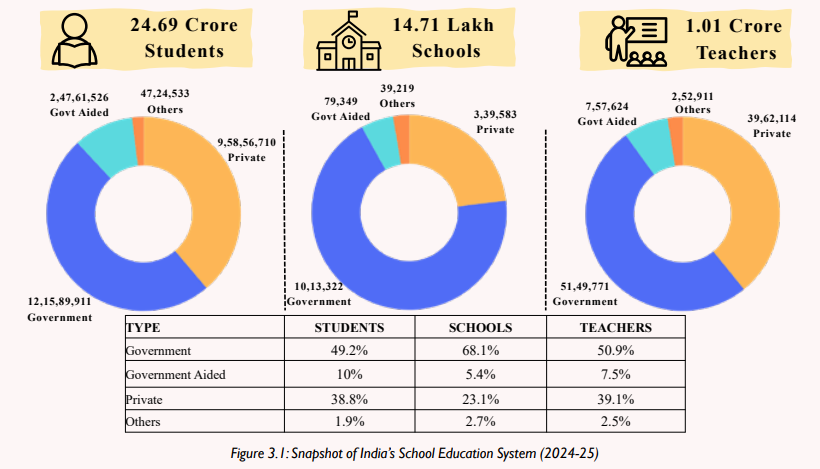
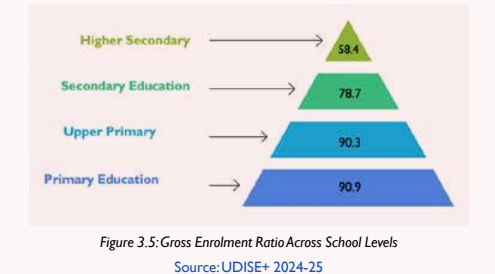
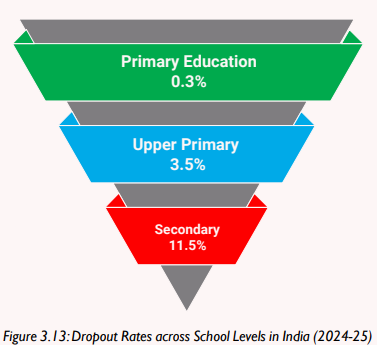
- While India has achieved a near-universal access to school at the primary level, it faces challenges in retaining students at the secondary level.
- Four out of every 10 children who enter the system drop out before completing higher secondary education.
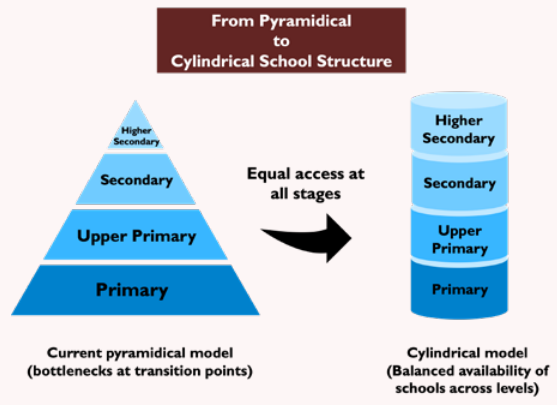
- This structural fragmentation means only 5.4% of schools offer a continuous journey from Grade 1 to 12.
- Transition in Infrastructure: Foundational facilities such as electricity and sanitation have reached high levels of coverage across most States, the remaining gaps are concentrated in specific geographies.
- Digital Access: The growth in access to computers and internet connectivity signals an accelerated push towards digital enablement.
Recommendations as per the Report
- Integrate Digital Infrastructure into Teaching, Learning, and School Governance.
- Strengthen Laboratories, Libraries, and Resource Centres for Experiential Learning.
- Strengthen School Management Committees and Institutionalise Bottom-Up Planning.
- Improve Teacher Preparation, Subject Expertise, and Professional Development.
- Prevent and Address Dropouts through Education Continuity and Re-Entry Pathways.
- Shift from Textbook Completion to Foundational Mastery and Level-based Instruction.
- Build Market Linkages and Enhance Regional Relevance of School-based Vocational Education.
Government Initiatives
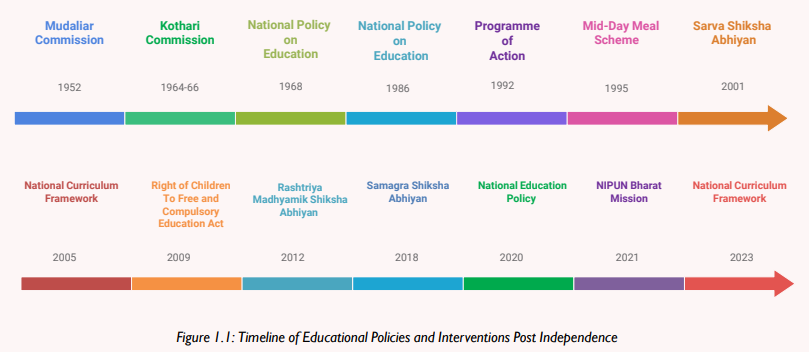
- Right to Education (RTE) Act, 2009: Guarantees free and compulsory education for children in the 6-14 age group, focusing on quality education and no discrimination.
- Mid-Day Meal Scheme: Provides free meals to students in government schools to encourage school attendance, improve nutrition, and reduce dropout rates.
- Pradhan Mantri Jan Dhan Yojana (PMJDY): Focuses on financial inclusion, enabling students from low-income families to access government education benefits and scholarships.
- National Scheme of Incentive to Girls for Secondary Education: Aims to encourage girls from rural areas to continue education by providing financial incentives.
- Swachh Vidyalaya Abhiyan: Improves sanitation facilities in schools, ensuring clean drinking water, toilets, and better hygiene to support girls’ education.
- Digital India Programme: Promotes the integration of technology in education by providing access to digital learning resources and bridging the digital divide.
- Scholarships and Financial Aid: The government offers various scholarships and financial assistance programs for students from economically weaker sections, such as the Post-Matric and Pre-Matric scholarships.
- New Education Policy 2020:
- Emphasis on early childhood care and education (ECCE), particularly for children up to 6 years.
- Encourages multi-disciplinary learning at the school and higher education levels.
- Introduction of a 5+3+3+4 school structure (5 years of foundation, 3 years of preparatory, 3 years of middle, and 4 years of secondary education).
- Focus on critical thinking, creativity, and problem-solving rather than rote learning.
Source: AIR
Previous article
Supreme Court on Election Commission Appointments
Next article
Reforming India’s Overcrowded Prison System
